

How Fall Leaf Buildup Can Turn Into Gutter Damage on Clinton Homes

Every gutter system, regardless of construction method, has to manage the expansion and contraction that comes from temperature change. Metal expands when heated and contracts when cooled, and Connecticut's climate produces significant temperature swings across every season: hot, humid summer days followed by cool nights, and winter conditions that cycle through freezing and thawing repeatedly.
A layer of dry leaves may look harmless. After several rain events, that material can become a compacted mass that slows drainage, traps moisture, and adds weight. Routine buildup can turn into clogged gutters, leaking gutters, loose hangers, damaged fascia, and drainage problems around the home.
The progression is not always obvious from the ground. Water may spill over one corner while the real blockage sits at the downspout outlet. A gutter may begin to sag only after wet leaves have held water in the same low area for days. By the time staining appears on the siding or fascia, the system may have been struggling through several storms.
Professional gutter cleaning in Clinton, CT is therefore more than a cosmetic task. It restores flow and creates an opportunity to inspect the system before leaf buildup turns a maintenance issue into a repair.
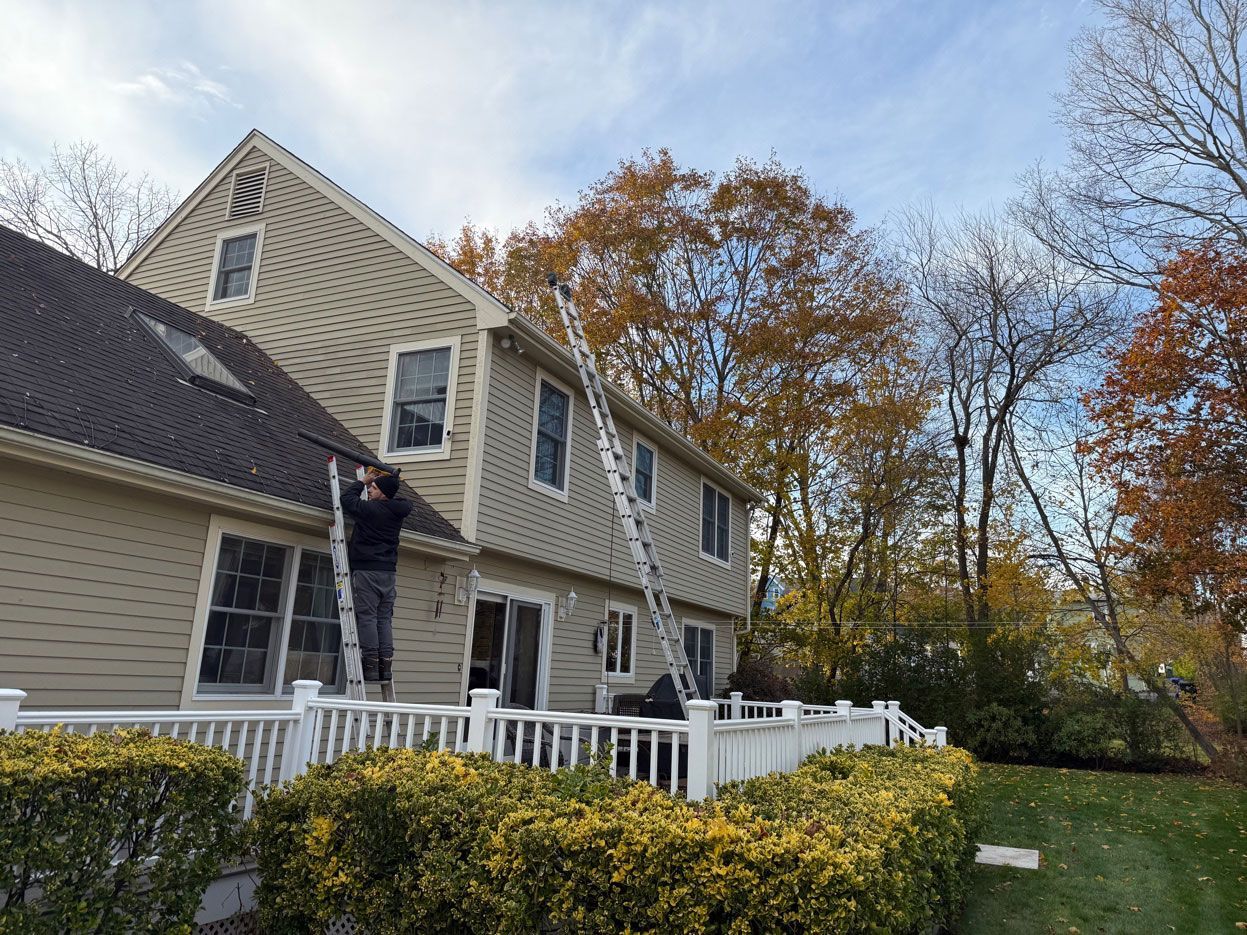
Why the Fall Timing Matters on the Clinton Shoreline
Clinton's fall conditions create a difficult overlap for roof drainage. Connecticut's Department of Energy and Environmental Protection says foliage season begins in late September and continues through early November. That means leaves, stems, acorns, pine needles, and small twigs can enter gutters over several weeks rather than all at once. See Connecticut DEEP's foliage-season guidance.
At the same time, the National Weather Service explains that nor'easters can happen during any season but are most frequent and strongest from early fall through spring. These East Coast storms can bring heavy precipitation, strong wind, rough coastal conditions, and flooding. Learn how the National Weather Service defines nor'easters.
That transition into October matters because a gutter that handled summer rain may react differently once the outlet is partly covered. Wind can add debris before the previous layer dries. Hard rain then tests every outlet, seam, hanger, and downspout connection.
The same pattern affects Madison, Westbrook, and Old Saybrook, but debris load varies by property. A wooded inland lot may collect more leaves, while an exposed shoreline home may receive more windblown material. Tree canopy, roof shape, and drainage layout matter more than the town name alone.
How Loose Leaves Become a Dense Gutter Blockage
Fresh leaves rarely form a solid obstruction immediately. They settle along the gutter bottom or gather around an outlet. Rain softens them, runoff carries particles into the gaps, and new layers compress the material below. Needles, seed pods, grit, and dirt can bind the pile together.
The outlet is often the first critical point. It is smaller than the gutter channel, so a modest cluster of leaves can reduce flow before the rest of the run looks full. Water begins backing up behind that restriction, and more debris settles out of the slower-moving water. The result is a self-reinforcing clog.
| Stage | What is happening inside the gutter | What a homeowner may notice |
|---|---|---|
| Loose accumulation | Dry leaves and small debris settle in the run | Little or no visible problem |
| Partial outlet restriction | Water drains, but more slowly than the roof supplies it | Overflow appears only in harder rain |
| Compacted leaf mat | Wet organic material traps grit and holds moisture | Standing water, odor, plant growth, or staining |
| Full blockage | Water cannot reach or enter the downspout properly | Heavy overflow near the outlet or along the run |
| Repeated saturation | Debris weight and retained water stress the system | Sagging, loose hardware, seam leaks, or fascia exposure |
This is why a quick glance from below can be misleading. The top of the gutter may not appear packed, yet a blockage at the outlet can still limit most of the system's capacity. The most consequential clog may be only a few inches wide.
What Happens When Water Cannot Reach the Downspout
Every roof concentrates rainfall into its gutter system. The U.S. Department of Energy's Building Science Education program notes that only a few inches of rain on a roof can generate several thousand gallons of runoff. Gutters and downspouts are meant to move that water away from the building so the soil around the foundation is less likely to become saturated. Read the federal guidance on gutters and roof runoff.
When leaves restrict the path, runoff keeps arriving. Water rises until it spills over the front, travels behind the gutter, or finds an open joint. Front-edge overflow can erode soil. Water behind the gutter can wet the fascia and soffit. A weak corner may drip because backed-up water remains against it longer.
A clogged downspout can also create a false diagnosis. The overflow may occur far from the blockage because the entire run has filled. Sealing the visible drip will not restore flow. The gutter must be cleared and flushed so its pitch, seams, and attachment can be evaluated under normal drainage conditions.
Discharge matters too. Even when water reaches the downspout, it still needs a safe route away from the home. A disconnected elbow, blocked underground line, or short extension can concentrate runoff beside the foundation. A complete fall inspection follows the water from the roof edge to the final discharge point.
How Wet Leaf Weight Pulls Gutters Out of Position
Dry leaves are light. Saturated leaves combined with standing water are not. That extra load is spread unevenly, with the greatest stress often developing near a blocked outlet or existing low spot. If hangers are loose, widely spaced, or attached to weakened fascia, the gutter can begin to move away from its intended position.
Even a small alignment change matters. Gutters depend on controlled pitch toward their outlets. When one area drops, water collects there, captures more sediment, and keeps the leaf mass wet. Leaf buildup can create a cycle of load, sagging, and additional buildup.
Sometimes the aluminum remains repairable and only the attachment or pitch needs correction. In other cases, a branch impact or prolonged sag distorts the gutter profile. Once the channel is twisted, simply adding a hanger may not restore dependable flow. The surrounding fascia must also be checked because new hardware cannot hold securely in deteriorated wood.
This is one reason homeowners should not assume every visible sag is caused by old gutters. A relatively sound run may be overloaded by debris. Conversely, removing the leaves does not automatically solve a sag if the hangers, fascia, or gutter shape have already been damaged.
Why Trapped Moisture Leads to Leaks and Fascia Trouble
Gutter joints and attachment areas perform best when water moves through the system and exits. A wet leaf mat changes that pattern by holding moisture against seams, end caps, corners, and the back of the gutter. Small sealant gaps that remain quiet during normal flow may begin leaking when water stands against them.
On sectional gutters, every mid-run joint is another potential leak point. Seamless systems remove those joints from straight runs, but they still have sealed connections at corners, outlets, and end caps. Seamless does not mean the entire system has no joints or maintenance needs.
Water behind the gutter deserves prompt attention. It can leave dark streaks, peeling paint, softened wood, or staining under the eave. A mark does not prove the fascia is rotten, but it shows water is reaching a protected area. Inspection can distinguish recent exposure from deeper deterioration.
Retained moisture can also hide the original cause. A leaking corner may need new sealant, but if the outlet remains blocked, the repaired joint will continue sitting in backed-up water. Lasting gutter repair in Clinton, CT starts by restoring flow, drying and preparing the repair area, and confirming that the run drains at the proper pitch.
Warning Signs That Leaf Buildup Is Causing Damage
The best time to identify gutter damage from leaves is before a section separates or the fascia becomes visibly soft. Homeowners can document the system safely from the ground during rain and inspect the surrounding property after the weather clears.
Watch for these signs:
- Water spilling over one point near a downspout, inside corner, or roof valley
- A waterfall along most of the run, suggesting a major blockage or insufficient drainage capacity
- Standing water that remains in the gutter after the rain ends
- A dark debris line visible above the front edge
- A gutter bowing or pulling away from the fascia
- Drips at seams, end caps, corners, or outlet connections
- Stains, peeling paint, or damp marks behind or beneath the gutter
- Washed-out mulch, soil channels, or puddles directly below the roofline
- Little or no flow from a downspout while the gutter above it is overflowing
One sign does not always reveal the whole problem. Overflow may come from debris, pitch loss, inadequate outlet capacity, or a combination of conditions. Photos or short videos can help show where the water first appears and whether the downspout is discharging at the same time.
Avoid climbing during rain, wind, or unstable ground conditions. Multi-story gutters, steep rooflines, nearby utility lines, and hanging branches should be evaluated professionally. Clearing a reachable downspout extension from the ground is different from leaning a ladder against a wet roof edge.
What Professional Fall Gutter Cleaning Should Accomplish
A useful cleaning does more than remove visible debris. The system should be cleared end to end, and each downspout flushed to confirm flow. Once the blockage is gone, the technician can see whether the gutter returns to position and drains fully.
Every CT GutterPro Clinton gutter cleaning visit includes complete debris removal, downspout flushing, pitch and hanger checks, inspection of cracks and open joints, a fascia-condition check, and a report of the findings. This makes the visit both maintenance and an early-warning opportunity.
The inspection should answer several practical questions:
- Did the overflow stop once the system was cleared?
- Does water now move toward every outlet without pooling?
- Are hangers secure and appropriately supporting each run?
- Did any seams, corners, or end caps continue leaking after normal flow returned?
- Is the fascia behind the attachment points firm?
- Does each downspout discharge where the property can manage the water?
If the system is clear, aligned, secure, and watertight, cleaning may be all that is needed. If a seam still leaks, a section remains low, or a hanger will not hold, the buildup has revealed a mechanical problem. CT GutterPro provides gutter repair in Clinton for those localized failures and explains the scope before work begins.
Scheduling also depends on the property. Most Clinton homes benefit from a late-spring cleaning and another after the main leaf drop. A heavily wooded lot or a home with several roof valleys may need an additional visit. Gutter guards can reduce large debris entry, but they still require inspection and periodic maintenance based on the guard type and surrounding canopy.
What Fall Gutter Cleaning and Leaf-Related Repairs Cost
Estimated 2026 Market Context
We currently publish $150 to $350 as a typical CT Shoreline planning range for professional gutter cleaning. The actual price depends on gutter length, home height, access, debris volume, and whether guards affect the cleaning process. CT GutterPro confirms exact pricing for the property rather than treating the range as a fixed quote.
Repair is priced after inspection because leaf buildup can expose anything from one leaking corner to several loose hangers or damaged fascia. For outside market context, HomeGuide's 2026 cost data places common gutter repairs at $100 to $450 nationally, with sagging-gutter repairs at $75 to $300 and leak repairs at $100 to $225.
Review HomeGuide's 2026 gutter repair cost guide.
| Service or condition | 2026 planning context | Important qualifier |
|---|---|---|
| CT GutterPro professional gutter cleaning | Typically $150–$350 | Published CT Shoreline range, with exact pricing based on the home |
| National common gutter repair | $100–$450 | Independent market range, not a CT GutterPro quote |
| National sagging-gutter repair | $75–$300 | Scope changes if fascia or gutter sections are damaged |
| National gutter-leak repair | $100–$225 | Cost depends on location, preparation, material, and access |
| CT GutterPro on-site estimate | Free | Property-specific assessment and written scope |
The cheapest visit is not necessarily the one that removes the most visible leaves in the least time. A proper service should confirm downspout flow and identify damage while it is still localized. Height, access, guard removal, roof complexity, and the condition behind the gutter can all affect the work.
Protect the Roofline Before Buildup Becomes Damage
Fall leaves do not damage every gutter they enter. The risk grows when debris blocks an outlet, stays saturated, traps standing water, or adds enough load to expose weak hangers and fascia. Cleaning interrupts that progression before repeated storms turn a flow problem into physical damage.
CT GutterPro has served Connecticut homeowners since 1986. Our Clinton cleaning process clears the system, flushes the downspouts, checks pitch and hangers, reviews seams, and inspects the fascia so you receive a complete picture rather than a bag of leaves and unanswered questions. We are licensed and insured under HIC #0706616.
If you see overflowing, sagging, stains, or little flow from a downspout, call (475) 286-8063 or request a free estimate. We will inspect the cause and explain whether your Clinton home needs cleaning, a focused repair, or a more complete tune-up.
Related Services & Pages
Gutter Tune-Up and Inspection in Clinton
Gutter Cleaning vs. Gutter Repair for Clinton Homes
Spring Gutter Cleaning vs. Fall Gutter Cleaning in Connecticut