

Why Older Gutters Start Failing During Fall Storm Season in New Haven

Every gutter system, regardless of construction method, has to manage the expansion and contraction that comes from temperature change. Metal expands when heated and contracts when cooled, and Connecticut's climate produces significant temperature swings across every season: hot, humid summer days followed by cool nights, and winter conditions that cycle through freezing and thawing repeatedly.
An older gutter system may look serviceable on a dry afternoon and then overflow, leak, or pull away from the roofline during the next hard rain. That timing can make the storm seem like the entire cause. More often, the storm is a stress test that exposes wear already developing in hangers, seams, outlets, pitch, fascia, or downspouts.
This pattern is common around older New Haven homes. Long runs, additions, dormers, mature trees, and previous roofline repairs can create weak points that are difficult to see from the ground. The practical question is where the system is failing, why it is failing, and whether the surrounding material is still sound.
If your search for gutter repair New Haven CT brought you here, the clues below can help you understand what a professional inspection should examine and when a focused repair may be enough.
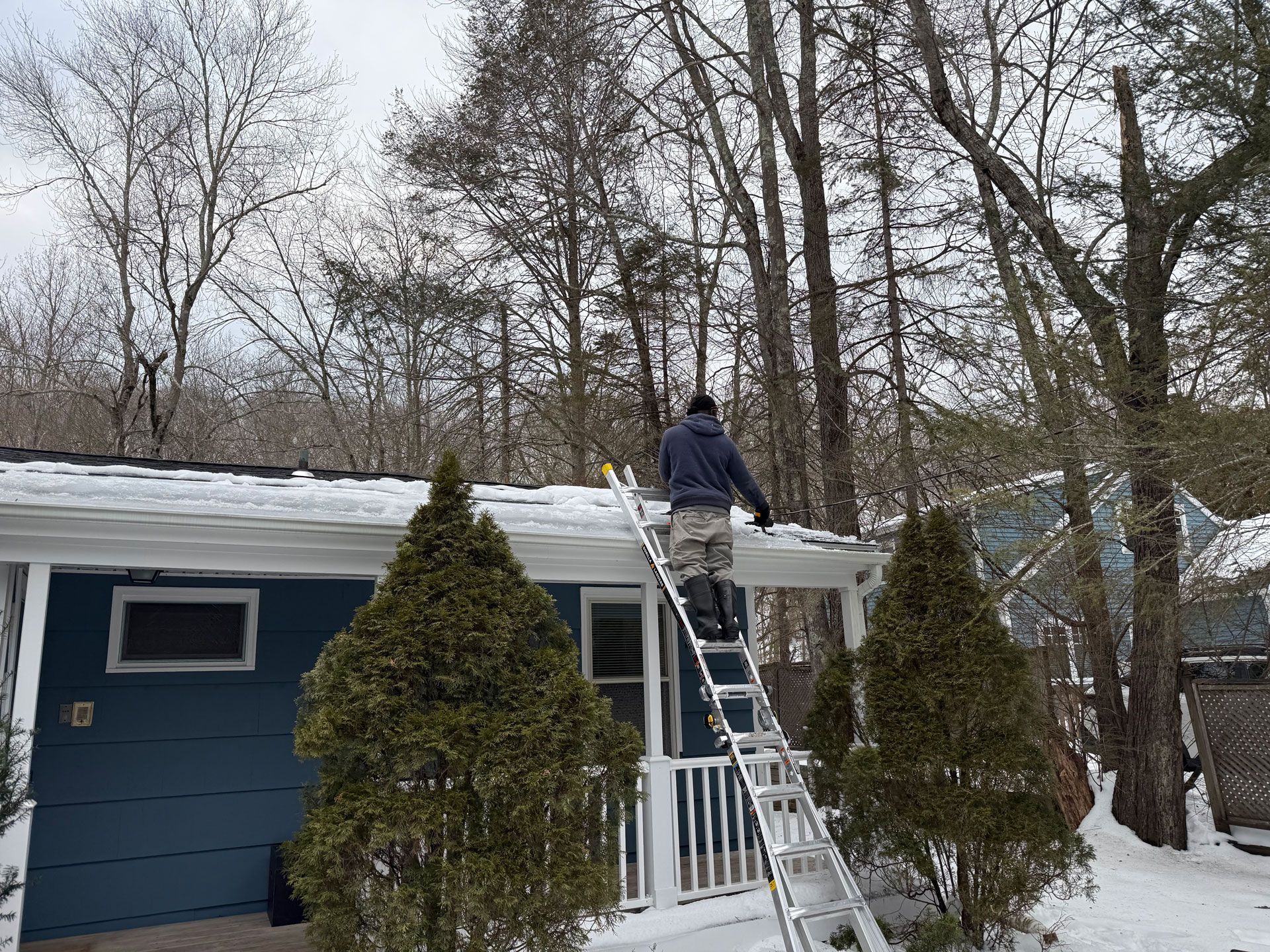
Why Fall Storms Expose Weaknesses in Older Gutters
Gutters collect runoff from an entire roof and move it through relatively small outlets. Fast rain, falling leaves, twigs, and windblown debris make that job harder. A partly restricted downspout may cope with light rain but back up during a downpour. A loose hanger may hold an empty gutter but flex when the channel fills.
The seasonal transition matters. As September gives way to October, New Haven is still receiving meaningful rainfall while deciduous debris increases. NOAA's 1991–2020 climate normals for Tweed New Haven Airport show average precipitation of 4.03 inches and 3.78 inches for those months, respectively. Those figures are long-term averages, not a forecast, but they help explain why a marginal drainage system can reveal itself at this time of year. Review NOAA's New Haven climate normals.
Wind adds stress. Branches can dent a run, debris can block an outlet, and movement can worsen a weak attachment point. Near Morris Cove, exposure differs from a sheltered inland street. In tree-lined areas of Hamden or New Haven, debris may be the bigger concern. The same visible overflow can have different causes, so diagnosis should come first.
The Gutter Parts That Usually Fail First
Age affects a gutter system component by component. One old section may still drain correctly while another has lost pitch or separated at a corner. The table below connects common failure points with what a homeowner may notice during or after rain.
| Component | What changes over time | Common storm symptom |
|---|---|---|
| Hangers and fasteners | Fasteners loosen, spacing proves inadequate, or the attachment substrate weakens | A low spot, vibration, or a gutter pulling away from the fascia |
| Seams, miters, and end caps | Sealant shrinks, cracks, or separates from the metal | Dripping at a joint or corner even when the channel is clear |
| Gutter pitch | A run settles as attachments move | Standing water, sediment lines, or overflow away from the outlet |
| Outlets and downspouts | Leaves and compacted debris restrict flow | Water rises near the outlet or spills over one end of the run |
| Fascia board | Repeated wetting can soften or deteriorate the mounting surface | Fasteners no longer hold, staining appears, or several hangers loosen |
| Gutter metal | Corrosion, punctures, dents, or fatigue reduce integrity | Pinholes, cracks, distorted sections, or repeated leaks |
This is why leaking gutters should not be diagnosed from the drip alone. Water at a seam may indicate failed sealant or be the escape point for a backed-up run. A sag may come from one failed hanger, standing water, or weakened fascia. Fixing the symptom without addressing the cause often brings only temporary relief.
Older New Haven rooflines may have changed over decades. An addition can send more water into an original gutter than its layout was designed to handle. A complete inspection follows the water from roof surface to discharge point.
How Leaves Turn Small Defects Into Major Overflows
Leaves do not need to fill a gutter to cause trouble. A small mat over an outlet can slow discharge enough for water to rise across the run. Fine material settles beneath it, holding moisture and adding weight. Any low spot becomes a collection point.
Once water reaches the top edge, it follows the easiest path. It may pour over the front, move behind the gutter, or escape through the weakest joint. That makes a clog look like a seam failure and can make an attachment problem worse. Debris, standing water, and loose fasteners often form a cycle rather than three separate issues.
The U.S. Department of Energy's Building Science Education program notes that a few inches of rain on a roof can create several thousand gallons of runoff. Gutters and downspouts help keep that water from saturating soil around the foundation. Read the federal building-science guidance on roof runoff. Not every overflow damages a foundation, but a defect can send substantial water where the property was not designed to receive it.
In Branford, shoreline exposure may bring wind-driven debris. In North Haven and wooded parts of Hamden, canopy density can make outlet restrictions more frequent. Cleaning restores flow only when the underlying gutter, hangers, pitch, and fascia remain sound. If the channel stays low or continues leaking after it is cleared, the system needs a closer look.
Why Leaking Gutters and Sagging Gutters Often Appear Together
Sagging changes how water moves. A properly pitched run directs runoff toward an outlet. When a hanger loosens or the fascia no longer holds the fastener firmly, a low section develops. Water remains there after the storm, placing continued load on the same weak area. Sediment and organic debris collect in the standing water, adding more weight.
That change in shape also stresses seams and corners. A joint that was sealed when the sections aligned may open as one side drops. On a seamless run, there are fewer mid-run joints, but there are still connections at corners, end caps, and outlets. Seamless does not mean maintenance-free or joint-free everywhere.
Water marks can show the sequence. A dark line inside the gutter can reveal standing water. Staining behind the run may indicate overflow or water between the gutter and fascia. A gap widening toward the center of a sag points to attachment trouble. Multiple loose sections suggest more than one failed screw.
This matters on older homes with repaired or layered fascia. A fastener may look loose because the wood no longer provides a secure hold. Driving another fastener into the same area does not restore the roofline. The fascia must be addressed first.
What Gutter Damage From Storms Looks Like From the Ground
Homeowners can document useful evidence without climbing onto a wet roof. Observe the system from a safe location during rain if conditions allow, then look again after the weather has cleared. The most useful signs are specific and repeatable:
- Overflow at one point may indicate a blocked outlet, a roof valley concentrating water, or a localized low spot.
- Overflow along most of a run may point to widespread blockage, poor pitch, inadequate capacity, or too few functioning outlets.
- Dripping from a corner or end cap suggests a joint or seal problem, especially if the gutter is not backed up.
- A visible gap behind the gutter can indicate loose hangers, failed fasteners, or fascia deterioration.
- Standing water after the storm shows that the run is not draining completely.
- Fresh dents, twists, or displaced downspouts can indicate direct gutter damage from storms or fallen branches.
- Soil washout, splash marks, or water near the foundation shows that runoff is landing where it should not.
Ground-level photos and short videos can show when and where failure occurs. Include the roofline and the problem area. A close-up alone may hide the valley, outlet, or sag that explains the drip.
Do not place a ladder on wet, soft, or unstable ground to investigate. OSHA's ladder-safety guidance emphasizes controlling slipping hazards and using ladders safely. See OSHA's ladder safety guidance. For a multi-story home, a steep roofline, nearby electrical service, or storm damage involving branches, professional evaluation is the safer choice.
When Gutter Repair Is Usually Enough
A focused repair makes sense when the defect is isolated, accessible, and supported by sound surrounding material. The goal is to restore secure attachment and drainage without replacing serviceable sections.
Repair may be appropriate when an inspection finds:
- One loose or damaged hanger while the fascia remains solid
- A localized leaking seam, corner, end cap, or outlet connection
- A short section with correctable pitch
- A downspout connection that has separated
- A small area damaged by a branch or ladder
- A blockage followed by normal flow once the system is cleaned and flushed
At CT GutterPro, our gutter repair service includes an assessment of the failure before work begins. We repair sagging sections, leaking joints, loose attachments, pitch problems, damaged areas, and downspout connections when those repairs offer a sensible result. We do not treat every leak as a reason to replace the entire system.
The condition after cleaning is revealing. If the gutter drains, holds alignment, and stays secure, maintenance and a limited repair may solve the problem. If water still ponds or several attachments move, the scope is larger. For homeowners considering gutter repair in New Haven, CT, fascia condition and the number of failing areas matter more than age alone.
When Seamless Gutter Replacement Makes More Sense
Replacement makes more sense when failures are widespread, recurring, or tied to a layout that no longer handles the roof. Sealant will not correct a misshapen run. More fasteners will not solve deteriorated fascia. Repeated clearing will not fix a poorly placed discharge path.
Common indicators include multiple sagging runs, corrosion across long sections, repeated seam failures, chronic standing water, extensive fascia deterioration, or storm damage that has distorted the gutter profile. A system assembled from many short sections may also develop leaks at numerous joints, making another round of patching less useful.
A professional recommendation for gutter replacement in New Haven, CT should explain more than why the old material is failing. It should also show how the new design will improve the water path. CT GutterPro fabricates seamless aluminum gutters on site and evaluates pitch, downspout placement, roof area, fascia, and drainage needs as part of the installation. Learn how CT GutterPro approaches seamless gutter installation.
Seamless gutter replacement reduces the number of joints along straight runs, which removes common leak points found in sectional systems. It does not eliminate corners, outlets, end caps, cleaning, or inspection. The best replacement is a complete drainage plan, not simply new aluminum attached in the same configuration.
If one section has failed, full replacement may be unnecessary. If several elevations show the same pattern, a project-wide solution may cost less over time than repeated service calls. The companion guide on gutter repair vs. replacement for older New Haven homes explains that decision in more detail.
What Gutter Repair and Replacement May Cost in 2026
Estimated 2026 Market Context
CT GutterPro does not publish one flat repair or replacement price because roof height, access, linear footage, material, corners, downspout needs, fascia condition, and damage extent change the scope. The figures below are
independent national planning ranges, not CT GutterPro quotes or Connecticut-specific guarantees.
| Service | 2026 national planning range | What can change the total |
|---|---|---|
| Typical gutter repair | $100–$450 total | Damage type, length, height, access, and material |
| Sagging gutter repair | $75–$300 | Number of hangers, pitch correction, and fascia condition |
| Gutter leak repair | $100–$225 | Joint type, hole size, sealant failure, and access |
| Seamless gutter repair | $150–$750 | Length of the affected run and whether it can be repaired in place |
| Seamless gutter installation | $6–$20 per linear foot | Material, labor, corners, roof complexity, removal, and eave repairs |
HomeGuide reports the repair ranges above in its 2026 gutter repair cost guide and the installation range in its 2026 seamless gutter cost guide. Its seamless estimate uses 150 linear feet as the example basis and lists old-gutter removal, corners, home configuration, and fascia or soffit work among the cost factors.
These ranges help with early budgeting, but they cannot show whether a New Haven home needs one hanger reset, fascia work, a new downspout layout, or complete replacement. We provide a free on-site estimate with exact project pricing after inspecting the roofline and drainage path.
Schedule a Gutter Inspection Before the Next Storm
An older gutter usually gives warning before a major failure. A new drip, widening gap, repeated overflow point, or section that remains full after rain is evidence that the water path has changed. Catching the cause while it is still localized can preserve more of the existing system and protect the fascia behind it.
CT GutterPro has served Connecticut homeowners since 1986. We inspect the full route from roof edge to downspout discharge, explain what failed, and recommend repair when it is practical or replacement when the system is failing broadly. Our team is licensed and insured under HIC #0706616.
For an honest assessment of leaking gutters, sagging gutters, or other gutter damage from storms, call (475) 286-8063 or request a free estimate. We serve New Haven and surrounding Greater New Haven and shoreline communities with practical, property-specific recommendations.