

4 Reasons Seamless Gutters Outperform Sectional Gutters on Connecticut Shoreline Homes

Walk through any established neighborhood in Branford, Madison, or Guilford and the gutter systems on display tell a quiet story about what each homeowner decided years ago, whether they knew it at the time or not. Some homes have a single, continuous line of gutter running the length of the roof, broken only at the corners. Others have visible seams every ten to twelve feet, with connector hardware and sealant lines marking each joint.
That difference is not cosmetic. It is the single most consequential decision a Connecticut shoreline homeowner makes about their gutter system, and it determines how the system performs against nor'easters, salt air, freeze-thaw cycles, and the 48 inches of annual rainfall that every property on the shoreline has to manage.
Sectional gutters and seamless gutters solve the same basic problem with two fundamentally different construction methods, and the difference in how each one performs over time is well documented. This guide explains exactly why seamless gutters consistently outperform sectional systems, with a specific focus on what that performance gap means for homes in Branford, Madison, Guilford, Clinton, and Old Saybrook.
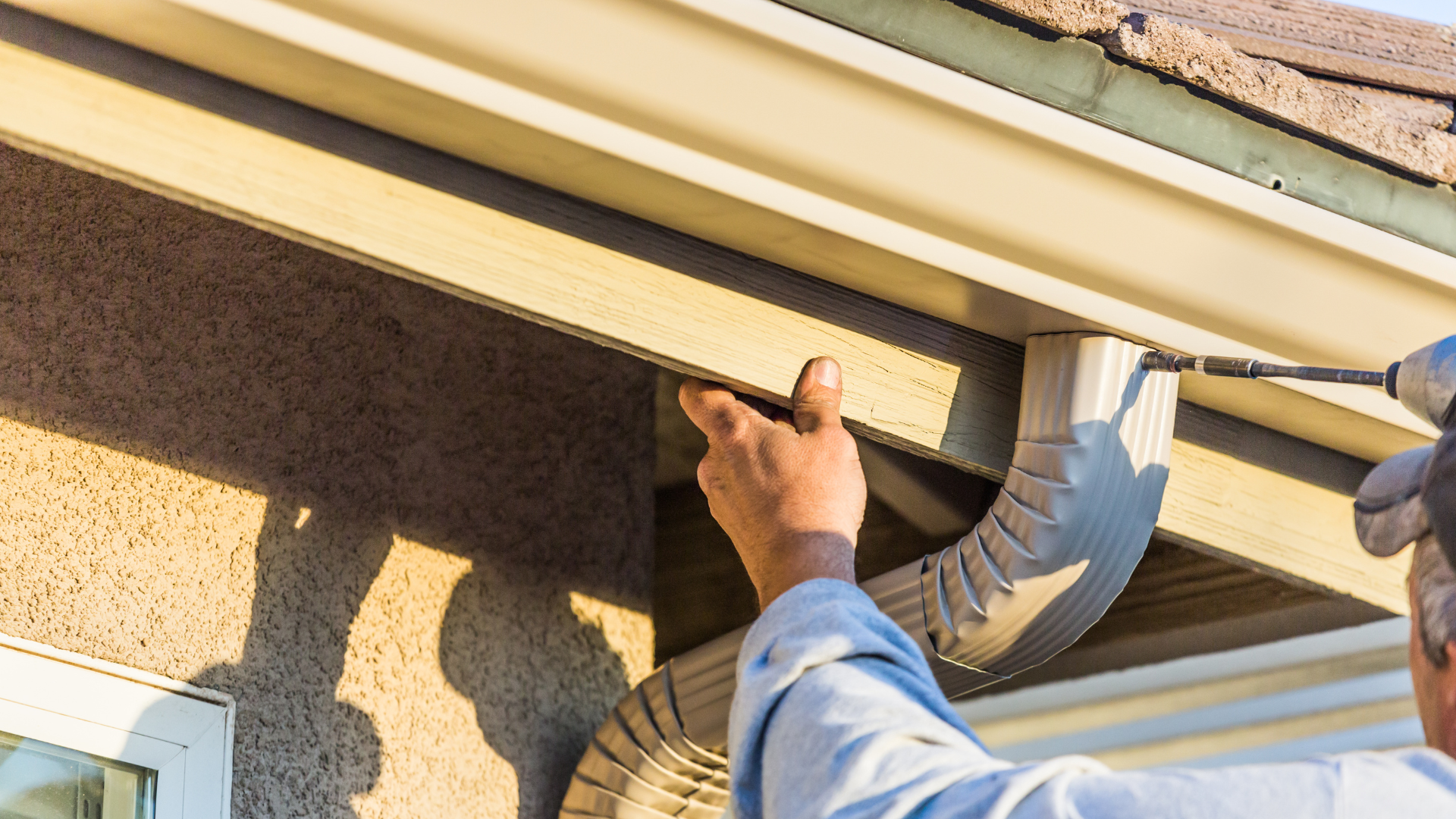
What Separates Seamless from Sectional Gutters
Before getting into performance, it helps to understand the construction difference that drives everything else.
Sectional gutters are manufactured in pre-cut lengths, typically 10 to 12 feet, sold at home improvement stores, and assembled on-site by joining multiple sections together with connectors and sealant. A standard residential gutter run requires multiple sections joined end to end, creating a seam approximately every ten to twelve feet along the entire length of the system.
Seamless gutters are fabricated on-site using a portable roll-forming machine that extrudes a continuous length of aluminum, cut to the exact measurements of each section of roofline. The only seams in a seamless system occur at corners and downspout outlets, typically four to eight joints total on a standard residential home, compared to fifteen to twenty joints on the same home with sectional gutters.
That single difference, in how many joints exist along the run, is the reason seamless gutters outperform sectional systems in every meaningful category for Connecticut shoreline homes.
Reason 1: Seamless Gutters Have 70 to 80 Percent Fewer Leak Points
Every joint in a gutter system is a place where water can eventually find its way through. According to verified industry comparison data, seamless gutters have 70 to 80 percent fewer potential leak points than sectional gutters because the construction method eliminates the mid-run seams that sectional systems depend on.
This matters more on the Connecticut shoreline than almost anywhere else in the country, for a specific reason that compounds the basic seam vulnerability: salt air.
Why salt air accelerates sectional gutter joint failure:
Properties in Branford, Old Saybrook, Clinton, and the coastal sections of Guilford and Madison are exposed to salt-laden air from Long Island Sound. Salt accelerates the breakdown of the sealants and connector hardware that hold sectional gutter joints together. A sealant that might hold for seven to ten years inland can degrade faster under sustained salt exposure, particularly at joints that are also managing the thermal expansion and contraction stress of Connecticut's seasonal temperature swings.
Each sectional joint depends on two things staying intact simultaneously: the mechanical connector and the sealant that seals it. When either one fails, water finds the gap. A fifteen-joint sectional system has fifteen opportunities for that failure. A seamless system with five or six joints, located only at corners and downspouts where they are easier to inspect and maintain, has a fraction of that exposure.
What this means in practice for Connecticut shoreline homeowners:
A sectional gutter system installed on a Branford or Madison home will, with near certainty, develop joint leaks within five to seven years as the combination of UV exposure, temperature cycling, and salt air works on the sealant. A seamless system installed under the same conditions has dramatically fewer points where that same process can produce a failure.
Reason 2: Seamless Gutters Handle Connecticut's Thermal Cycling Better
Every gutter system, regardless of construction method, has to manage the expansion and contraction that comes from temperature change. Metal expands when heated and contracts when cooled, and Connecticut's climate produces significant temperature swings across every season: hot, humid summer days followed by cool nights, and winter conditions that cycle through freezing and thawing repeatedly.
In a seamless gutter, this thermal movement is absorbed continuously across the full length of the run with minimal stress concentration. In a sectional gutter, the same thermal movement is distributed across each individual seam, and the repeated expansion and contraction at every joint progressively works the connector and sealant looser over time.
Why this matters more for winter performance:
Connecticut shoreline homes face nor'easter season and the freeze-thaw cycling that comes with it. A sectional gutter system that has fifteen joints, each one a slightly weaker point than the surrounding material, is fifteen locations where ice formation and thermal stress can find an existing weakness and exploit it. A seamless system with only four to eight joints distributes that same stress over far fewer vulnerable points.
The reduced joint count on a seamless system has a documented effect on ice-related failure specifically: fewer joints translate directly to less ice-dam-related failure, because there are fewer locations where ice can form at a weak point and begin separating the system.

Reason 3: Seamless Gutters Last Significantly Longer
Longevity is where the seamless versus sectional decision shows its clearest long-term value, and the data is consistent across independent sources.
According to verified industry data, seamless aluminum gutters last 20 to 30 years, while sectional gutters typically last 15 to 20 years depending on material and climate exposure. On the Connecticut shoreline, where salt air, nor'easter wind loading, and freeze-thaw cycling all accelerate wear at the seams of a sectional system, the actual lifespan gap between the two systems tends to widen further compared to inland installations.
The cost comparison that matters over a 10-year ownership period:
Seamless gutters cost more upfront, typically $6 to $15 per foot installed compared to $4 to $9 per foot for sectional systems, a difference of roughly 30 to 50 percent. For a typical Connecticut shoreline home, that translates to an upfront difference of $900 to $1,100 between the two systems.
What closes that gap, and according to multiple industry sources often equalizes the total cost over a decade, is maintenance. Sectional systems require more frequent cleaning, resealing, and joint repair as the seams age. Each of those service calls adds cost that a seamless system, with its dramatically reduced joint count, does not require at the same frequency. Over ten years, seamless and sectional gutters often cost about the same in total, but the seamless system produces less hassle and fewer water damage risks from leaks along the way.
For homes in Branford and Madison specifically, where salt air accelerates sectional joint wear beyond the national average timeline, the total cost of ownership comparison tends to favor seamless gutters even more strongly than the general data suggests.
Reason 4: Seamless Gutters Protect Everything Downstream More Reliably
A gutter system's job is not just to look intact. It is to manage water in a way that protects the fascia, the foundation, the landscaping, and the basement of the home it serves. This is where the leak point and longevity advantages of seamless gutters translate into protection for the rest of the property.
The protection chain that a leaking sectional joint compromises:
A leak at a sectional gutter seam does not stay contained to that joint. Water finds the path of least resistance, which often means it tracks behind the gutter and contacts the fascia board directly, rather than flowing through the downspout system as intended. Repeated wetting at a leaking joint location softens the fascia, compromises the hanger fasteners anchored in that wood, and can produce localized sagging that further disrupts the gutter's pitch and increases overflow at that section.
Once a sectional joint begins leaking, the damage is not static. It compounds: the leak wets the fascia, the fascia softens, the hangers lose their grip, the section sags, the sag worsens the leak. A seamless system, with its dramatically reduced number of joints where this sequence can begin, interrupts that failure chain before it has as many opportunities to start.
What this means for Connecticut shoreline properties specifically:
Homes in Guilford, Clinton, and Old Saybrook that face Connecticut's full 48 inches of annual rainfall, combined with nor'easter wind-driven rain that tests every seal in the system, depend on their gutters functioning correctly across every season without compromise. A seamless system that maintains its pitch, its seal integrity, and its fastening to the fascia more reliably over time is directly protecting the foundation, the basement, and the landscaping of the home it serves, not just the gutter itself.
Why Seamless Is the Professional Installation Standard
Seamless gutters are not a premium upsell. They are the professional installation standard for a specific practical reason: the equipment required to fabricate them, a portable roll-forming machine that costs thousands of dollars and requires training to operate correctly, is not something homeowners or unlicensed installers have access to. Sectional gutters persist primarily as a retail, DIY-accessible option precisely because they do not require that equipment.
For Connecticut shoreline homeowners evaluating a new gutter installation in Branford, Madison, Guilford, Clinton, or Old Saybrook, the choice between seamless and sectional comes down to a straightforward tradeoff: a modestly higher upfront investment in exchange for dramatically fewer leak points, better performance against salt air and thermal cycling, longer service life, and more reliable protection for the fascia, foundation, and structure the gutter system exists to protect.
CT GutterPro fabricates and installs seamless aluminum gutter systems on-site, custom-fit to the exact dimensions of each Connecticut shoreline roofline. With 40 years of experience and over 2 million feet of gutter installed across New Haven County and the surrounding communities, every seamless installation is sized, pitched, and fastened specifically for the conditions each property faces, from salt air exposure on coastal lots to the heavy debris loads under mature tree canopies further inland.