
How Connecticut's Heavy Rainfall and Freeze-Thaw Cycles Make Foundation Drainage a Year-Round Priority

Every gutter system, regardless of construction method, has to manage the expansion and contraction that comes from temperature change. Metal expands when heated and contracts when cooled, and Connecticut's climate produces significant temperature swings across every season: hot, humid summer days followed by cool nights, and winter conditions that cycle through freezing and thawing repeatedly.
Most homeowners in Branford, Guilford, Madison, and Old Saybrook think about drainage after something goes wrong. Water shows up in the basement following a heavy spring rain. The yard turns into standing water after a nor'easter. A corner of the foundation wall develops a stain that was not there last season.
By that point, the drainage system has already failed, and the question is no longer how to prevent the problem but how much it will cost to address it.
Connecticut does not give homeowners a dry season to catch up. According to NOAA's State Climate Summaries for Connecticut, the state averages 47.3 inches of precipitation annually, distributed across all twelve months, and annual precipitation has been generally above average since the 1970s. That water arrives in multiple forms — heavy summer thunderstorms, nor'easters, hurricane remnants, winter snowpack, and spring snowmelt — each one putting pressure on foundation drainage systems in a different way and at a different time of year.
CT GutterPro has been protecting homes across the Connecticut Shoreline since 1986. This is what the team sees on properties throughout Branford, Guilford, Madison, Milford, and Old Saybrook when drainage is treated as a seasonal concern rather than a year-round one.
What Connecticut's Climate Actually Does to Foundation Drainage
Understanding why foundation drainage is a year-round concern starts with what Connecticut's climate delivers across all four seasons. It is not one problem. It is four different problems that build on each other.
The NOAA National Centers for Environmental Information Connecticut State Climate Summary documents that extreme precipitation events in Connecticut, defined as single days receiving two inches or more of rainfall, have been most frequent during the 2005 to 2014 period, with Connecticut experiencing between two and three such events per year at a typical station. The frequency and intensity of extreme precipitation are projected to increase under current climate models, with spring and winter precipitation expected to see the largest gains.
NOAA's Billion-Dollar Weather and Climate Disasters data for Connecticut confirms that from 1980 through 2024, the state was affected by 45 confirmed weather and climate disaster events exceeding $1 billion each, including 17 winter storms, 13 severe storm events, and 3 flooding events. These are not rare occurrences. They are the pattern.
Here is how each season puts pressure on a property's drainage infrastructure:
| Season | Primary drainage threat on CT Shoreline properties |
|---|---|
| Spring | Snowmelt combined with increased rainfall saturates soil before it can dry; hydrostatic pressure against foundations peaks |
| Summer | Fast, intense thunderstorms overwhelm downspout capacity and surface drainage on properties without adequate yard grading |
| Fall | Leaf debris clogs gutters and downspouts, redirecting roof runoff toward the foundation rather than away from it |
| Winter | Freeze-thaw cycles expand moisture in soil against foundation walls, and ice damming in gutters sends meltwater behind the roofline |
The Freeze-Thaw Problem: What It Does to Foundations and Drainage Systems
Of the four seasonal drainage threats, freeze-thaw cycles are the one most homeowners in Guilford, Madison, and Old Saybrook underestimate because the damage is slow and invisible.
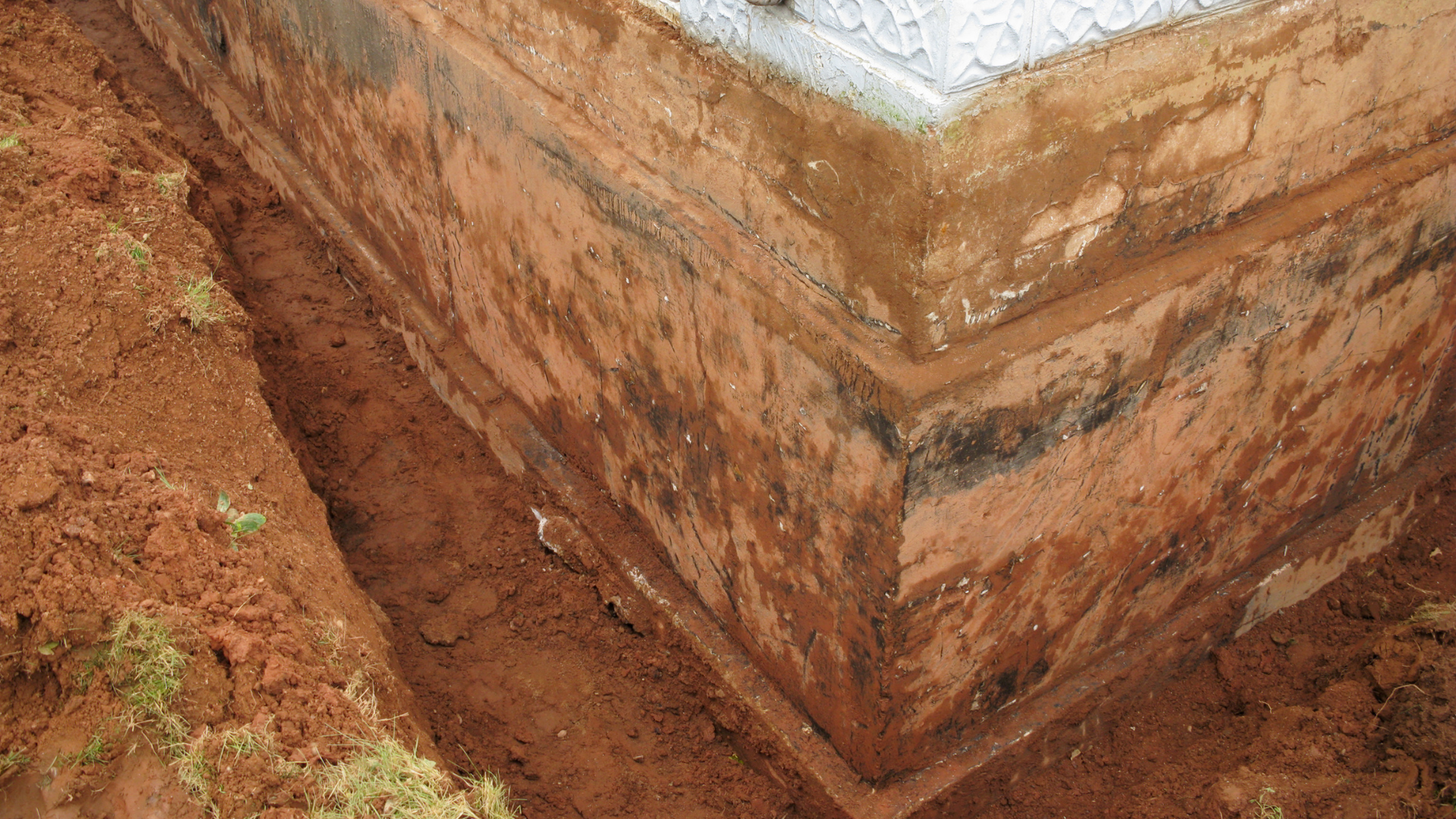
When soil around a foundation retains moisture and that moisture freezes, it expands. That expansion pushes against the foundation wall. When temperatures warm and the moisture thaws, the soil contracts, pulling back and leaving a gap. This cycle, repeated dozens of times through a Connecticut winter, is called frost heave, and its cumulative effect on foundations is significant.
Connecticut winters regularly produce the temperature swings that drive this process. While the state has seen a reduction in the number of very cold nights since the mid-1980s according to NOAA data, the pattern of temperatures crossing above and below freezing multiple times through a single week, which is what drives frost heave, remains characteristic of the region's winters. The CT Shoreline's proximity to Long Island Sound moderates temperatures slightly compared to inland areas, but it also keeps moisture levels elevated through the winter, which means the soil around Branford and Madison foundations remains wetter and more susceptible to freeze-thaw expansion than drier inland soils would be.
The damage this creates is not always visible immediately. Foundation walls develop hairline cracks over seasons of repeated pressure. Mortar joints in older block foundations deteriorate. The soil around the foundation settles unevenly as the gaps left by thaw fill with new water rather than returning to their original position. Over years, this becomes visible as water infiltration, bowing walls, or basement moisture that appears to have no single cause.
The preventive measure is keeping soil moisture around the foundation low enough that freeze-thaw expansion does not build up force against the wall. That requires drainage systems, both at the roofline and at grade level, that are functioning properly before winter arrives.
Why Downspout Extensions Are the Starting Point for Foundation Drainage
The most common foundation drainage failure CT GutterPro encounters on properties throughout Branford, Guilford, Madison, and Old Saybrook is the simplest one. A downspout that terminates within two or three feet of the foundation is delivering roof runoff directly to the soil zone that surrounds the foundation wall.
A typical Connecticut home roof sheds an enormous volume of water during a rain event. For a 2,000-square-foot roof receiving one inch of rain, that is roughly 1,250 gallons of water. Every gallon that drops from a short downspout within two feet of the foundation goes directly into the soil zone that is already under hydrostatic pressure. During a two-inch rain event, which Connecticut experiences between two and three times per year, that load more than doubles.
Downspout extensions redirect that water to discharge points well away from the foundation. CT GutterPro designs and installs downspout extensions as part of its drainage solutions service throughout the Shoreline, including properties in Branford, Guilford, Madison, and Old Saybrook where lot sizes and landscaping often require customized routing to reach an appropriate discharge point.
Extension length matters. A surface extension that discharges four to six feet from the foundation reduces the immediate saturation problem but may not be sufficient on properties where the grade slopes back toward the house. The proper discharge point is one where water moves away from the foundation on its own once released.
For a related look at how CT GutterPro evaluates and maintains the gutter systems that feed these downspouts, the CT GutterPro Gutter Tune-Up service addresses pitch, hanger condition, and downspout flow in a single visit.
French Drains: When Downspout Extensions Are Not Enough
On many properties along the Connecticut Shoreline, particularly in the older residential neighborhoods of Guilford, Madison, and North Branford, the underlying soil conditions make surface drainage management insufficient on its own.
Connecticut's coastal and inland soils vary significantly in drainage behavior. Shoreline communities often have a mix of sandy soils near the coast, which drain quickly but shift under load, and heavier loam or clay-dominant soils further inland, which retain moisture for extended periods after rainfall. In areas where the soil holds water at or near the surface after rain events, a French drain system is typically the right solution.
A French drain intercepts groundwater or surface water before it reaches the foundation. It consists of a perforated pipe set in a gravel-filled trench that channels water to a discharge point or dry well away from the structure. On properties in Guilford, Madison, and Old Saybrook where the water table rises seasonally or where low-lying areas of the yard consistently hold water after rain events, a properly installed French drain system relieves the hydrostatic pressure that would otherwise build against the foundation.
The installation depth matters for Connecticut properties specifically. Pipes installed too shallowly are vulnerable to frost heave movement during freeze-thaw cycles, which can shift the pipe out of alignment and reduce system effectiveness. CT GutterPro's French drain installations across Branford and the Shoreline are designed with Connecticut's freeze depth in mind and installed with gravel backfill specifications that accommodate seasonal soil movement.
How Gutters Connect to Foundation Drainage
Foundation drainage and gutter systems are not separate problems on a Connecticut property. They are one system, and a failure at any point in the chain affects everything downstream.
A gutter that is not cleaned before winter arrives fills with debris and ice. That ice dam sends meltwater behind the roofline, into the fascia, and down the exterior wall. That water lands at the foundation. A gutter with incorrect pitch holds standing water rather than directing it to the downspout. That standing water freezes, expands, and damages the gutter mounting, pulling the system away from the fascia. A downspout that is blocked or too short concentrates roof runoff at the foundation rather than directing it away.
The result in each case is the same: water at the foundation that should be eight or ten feet away from it.
CT GutterPro's gutter cleaning service is specifically structured to address the full system. Every visit includes debris removal, a complete downspout flush, and an inspection of pitch, hangers, seam seals, and fascia board condition. The team checks slope and downspout flow at the same time because they affect foundation drainage together.
The homes across the Connecticut Shoreline that CT GutterPro visits most frequently for drainage assessments are the ones where gutter maintenance and foundation drainage have been addressed separately rather than as parts of the same system. Fixing the downspout extension without addressing the clogged gutter feeding it does not solve the problem. Neither does cleaning the gutters while leaving a downspout that discharges eighteen inches from the foundation.
What Proper Year-Round Drainage Maintenance Looks Like
Given Connecticut's four-season precipitation pattern, foundation drainage maintenance has a specific seasonal rhythm that homeowners in Branford, Guilford, Madison, and Old Saybrook should follow to keep their systems performing.
| Time of year | Foundation drainage maintenance task |
|---|---|
| Late spring (May) | Clear winter debris from gutters and downspouts; inspect extensions for winter displacement or damage; check that all discharge points are clear |
| Early summer (June) | Verify yard drainage is flowing correctly ahead of summer storm season; address any standing water from spring that has not resolved |
| Late fall (October to November) | Full gutter cleaning after leaves have dropped; inspect and clear all downspout connections; confirm extensions are secured before ground freezes |
| Pre-winter (November to December) | Final inspection of all drainage discharge points; clear any debris from French drain outlets or dry well access points; note any areas of standing water that froze in prior winters |
CT GutterPro's gutter tune-up service combines cleaning, inspection, and minor repairs in a single visit and is the most efficient way to address the pre-winter maintenance window before the ground freezes and accessibility becomes more difficult.
If you are seeing signs of inadequate drainage on your Branford, Guilford, Madison, Milford, or Old Saybrook property — standing water, basement moisture, soil erosion near the foundation, or downspouts discharging too close to the house — CT GutterPro can evaluate the full system and recommend the right approach.
Drainage Solutions | Gutter Cleaning | Gutter Tune-Up | Branford Drainage Solutions | Guilford Drainage Solutions | Madison Drainage Solutions | Contact CT GutterPro